Central Dogma of Molecular Biology
The flow of genetic information from DNA to RNA to Protein
DNA Replication
Cell Cycle Phases: Interphase (S phase), Mitosis (PMAT: Prophase, Metaphase, Anaphase, Telophase), Cytokinesis
Key Enzymes: Helicase (unwinds DNA), Primase (RNA primers), DNA Polymerase III (synthesis), DNA Polymerase I (removes primers), Ligase (joins fragments)
Proteins: SSB proteins (stabilize single strands), Topoisomerase (relieves tension)
Process: Semiconservative replication at replication fork, leading strand (continuous), lagging strand (Okazaki fragments)
Transcription
Initiation: TATA box (promoter region), TFIID binds, RNA Polymerase II recruited
Key Enzymes: RNA Polymerase II (mRNA synthesis), RNA Polymerase I (rRNA), RNA Polymerase III (tRNA)
Elongation: Template strand read 3'→5', mRNA synthesized 5'→3'
Post-transcriptional Modifications: 5' cap (7-methylguanosine), 3' poly-A tail, splicing (remove introns via spliceosome)
Factors: Transcription factors (TFs), enhancers, silencers
Translation
Initiation: Small ribosomal subunit binds 5' cap, scans for start codon (AUG), large subunit joins
Machinery: Ribosome (large + small subunit), tRNA with anticodon, aminoacyl-tRNA synthetase
Elongation: A site (aminoacyl), P site (peptidyl), E site (exit), peptidyl transferase forms peptide bonds
Termination: Stop codons (UAA, UAG, UGA), release factors
Post-translational: Protein folding (chaperones), modifications (phosphorylation, glycosylation)
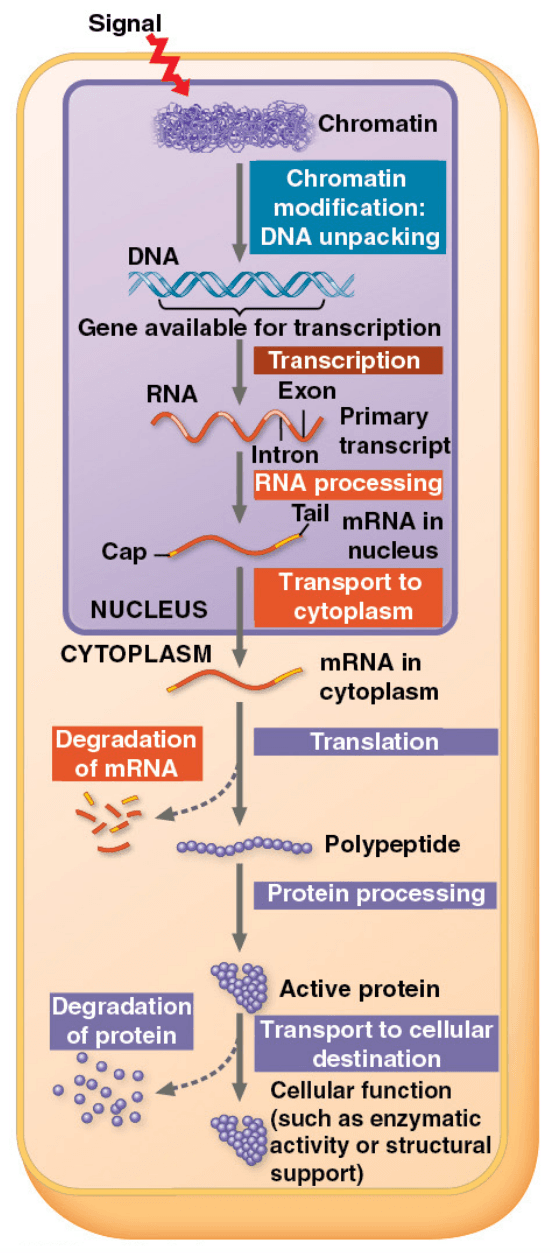
Flow of Information
Molecular Relationships
DNA ↔ Histones
DNA wraps around histone octamers (H2A, H2B, H3, H4) forming nucleosomes, compacting into chromatin for gene regulation
DNA → mRNA
Template strand transcribed to complementary mRNA (T→U substitution), carries genetic code from nucleus to cytoplasm
mRNA ↔ tRNA
Codon-anticodon pairing at ribosome A site, tRNA delivers specific amino acids based on genetic code
rRNA + Proteins → Ribosome
Ribosomal RNA (rRNA) and ribosomal proteins assemble into large (60S) and small (40S) subunits forming 80S ribosome
tRNA Structure
Cloverleaf structure with anticodon loop (binds mRNA), acceptor stem (binds amino acid), modified bases for stability
Genetic Code
64 codons (4³), 61 code for 20 amino acids (degeneracy), 3 stop codons, universal except mitochondria